Pain is one of the most difficult things to live with — and one of the hardest to treat. Medication helps but comes with side effects, dependency risks, and diminishing returns over time. So when people hear that binaural beats can reduce pain without drugs, the natural reaction is skepticism mixed with hope. This guide gives you the honest version: what the clinical evidence actually shows, which frequencies have real research behind them, and which claims (like the popular 174 Hz "natural anesthetic") do not.
The short version: there is genuine clinical evidence that theta binaural beats (4-8 Hz) reduce chronic pain intensity. Binaural beats are a valuable complementary tool — not a miracle cure, and never a replacement for medical care.

Photo: Vitaly Gariev on Unsplash
Quick Answer: What the Science Supports
For chronic pain relief, the best-supported frequencies are Theta binaural beats at 4-8 Hz, with daily sessions of 20-30 minutes building meaningful relief over 1-2 weeks. Delta frequencies (0.5-4 Hz) help indirectly through better sleep. The most rigorous evidence comes from two randomized controlled trials — Zampi (2016) for chronic pain and Gkolias (2020) for acute post-surgical pain — both showing real, measurable pain reduction with theta beats.
| Frequency | Band | Best for | Evidence |
|---|---|---|---|
| 6-7 Hz | Theta | Chronic pain, tension, anxiety-related pain | Strong (Zampi 2016, Gkolias 2020) |
| 4 Hz | Theta (low) | Deep relaxation, pain-related insomnia | Moderate |
| 0.5-2 Hz | Delta | Sleep restoration (indirect pain relief), migraines | Moderate (Dabiri 2022 for sleep) |
| 10 Hz | Alpha | Anxiety amplifying pain perception | Anecdotal / indirect |
| 174 Hz | Solfeggio (esoteric) | Claimed pain relief | None (no clinical studies) |
The Clinical Evidence: What Two Key Studies Found
Zampi 2016 — Chronic Pain Over Two Weeks
The most-cited study on binaural beats for chronic pain is Zampi (2016), published in Alternative Therapies in Health and Medicine. Participants listened to theta binaural beats once daily for two weeks. The theta group reported significantly lower perceived pain severity compared to a placebo control group. This is one of the landmark studies establishing theta binaural beats as an effective non-pharmacological audio protocol for chronic pain.
Gkolias 2020 — Pain Reduction and Less Medication
Gkolias et al. (2020) took this further in a randomized, double-blind, placebo-controlled trial. They found that theta rhythm binaural beats alleviated pain intensity both after a single 30-minute session and after a one-week on-demand listening protocol. Importantly, the theta group also used less analgesic medication than the control group — a meaningful clinical outcome, not just a subjective pain score.
Together these two studies are the strongest available evidence. They show that theta binaural beats are not a placebo trick: they produce measurable pain reduction and can lower medication use, with effects building over consistent daily practice.
How Binaural Beats Reduce Pain: The Mechanism
The exact mechanism is still being investigated, but the leading hypothesis involves the body's endogenous opioid system. Theta brainwaves are associated with deep relaxation, meditation, and the early stages of sleep — states in which the brain releases endorphins, the body's natural painkillers. Endorphins bind to opioid receptors and produce analgesia more potent than morphine.
By entraining your brain into theta, binaural beats may activate this natural pain-relief pathway. There are also indirect mechanisms: theta lowers anxiety and tension (which amplify perceived pain), and theta/delta improve sleep quality (when the body does much of its pain modulation). A 2024 meta-analysis confirmed that binaural beats in clinical populations also reduce anger, confusion, and tension — emotional states that worsen the experience of pain.
The 174 Hz Solfeggio Myth
If you have searched for "binaural beats for pain" you have undoubtedly encountered 174 Hz, marketed everywhere as a "natural anesthetic" or "miracle pain frequency." Here is the honest context: there are no clinical studies validating 174 Hz for pain relief. The 174 Hz pain narrative comes from sound-healing and esoteric Solfeggio traditions, not from peer-reviewed research.
174 Hz tracks may still help you relax, which can indirectly reduce pain perception — relaxation is genuinely pain-reducing. But if you want a frequency with actual clinical evidence, choose theta binaural beats (4-8 Hz). See our complete guide to Solfeggio frequencies for the broader context on which Solfeggio claims are scientific and which are traditional.
A Practical Protocol for Pain Relief
Based on the Zampi and Gkolias studies, here is a research-informed protocol:
- Use 6-7 Hz Theta as your main frequency. This is the range with the strongest clinical evidence. 4 Hz (low theta) works well if you also need help falling asleep.
- Daily sessions of 20-30 minutes. The Gkolias study showed benefits from a single 30-minute session; Zampi used daily sessions for two weeks. Consistency matters more than marathon sessions.
- Use stereo headphones. Binaural beats require each ear to receive a different frequency. See our headphones guide.
- Find a quiet space and lie down or recline. Lower frequencies (Theta, Delta) can make you drowsy — do not use them while driving or operating machinery. Pair the session with slow breathing or meditation.
- Set the volume low. The tones should be barely audible. Loud volume causes stress, not faster relief.
- Combine with low brown or pink noise (optional). A quiet layer of brown noise can help mask tinnitus or distracting sounds while you relax.
- Build a 2-week habit. The strongest effects came from consistent daily use. Set a daily reminder and treat it like a pain-management practice, not a one-off.
- Pair with sleep sessions at night. Pain disrupts sleep, and poor sleep worsens pain — a vicious cycle. Use Delta (0.5-2 Hz) at night to break it. See our deep sleep guide.
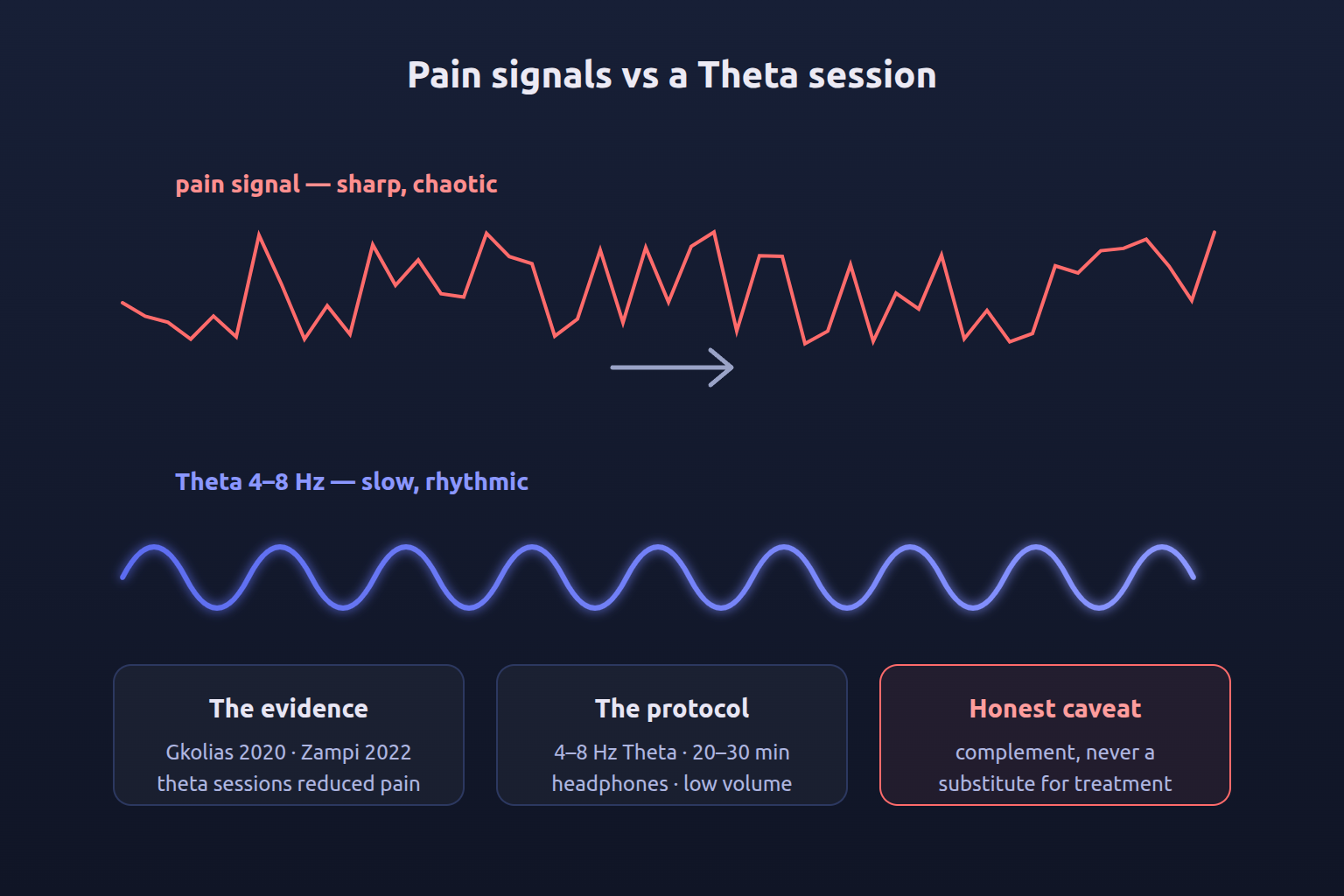
A sharp, chaotic pain signal vs the slow rhythm of a Theta session — the range with the strongest clinical evidence.
For Specific Pain Conditions
Chronic back or joint pain. Use 6-7 Hz Theta daily for 30 minutes. The Zampi 2016 protocol used exactly this setup for general chronic pain and found significant reduction after two weeks. Combine with gentle movement or stretching during non-listening hours.
Fibromyalgia. Theta binaural beats are safe for fibromyalgia and may help with the anxiety, sleep disruption, and central sensitization that characterize the condition. Use a daily 30-minute theta session plus a nighttime delta session. Always coordinate with your rheumatologist or pain specialist.
Migraines. Theta (4-8 Hz) can reduce migraine-associated tension and anxiety. During an active attack, very low delta (0.5 Hz with a 160 Hz carrier) is sometimes used in a dark, quiet room. Migraines are complex neurological events — binaural beats are a complementary tool, not a standalone treatment. See also our article on stress relief, since stress is a common migraine trigger.
Pain-related insomnia. Use 4 Hz Theta or 0.5-2 Hz Delta for 30 minutes before bed. The Dabiri 2022 study confirmed delta binaural beats improve sleep quality, which in turn improves the body's pain-modulation capacity.
Post-surgical pain. The Gkolias 2020 study was conducted on post-operative patients and found reduced analgesic use. If you are recovering from surgery, ask your medical team whether a theta binaural beats protocol is appropriate alongside your prescribed pain management.
What Binaural Beats Cannot Do
Honesty matters in pain management. Binaural beats will not:
- Cure the underlying cause of your pain. They reduce the perception of pain and may lower inflammation indirectly via stress reduction, but they do not fix a herniated disc, repair a torn ligament, or stop an autoimmune process.
- Replace prescribed pain medication on their own. They can lower the amount you need (per Gkolias), but tapering medication should always happen under medical supervision.
- Work the same for everyone. Pain is subjective and complex. Some people get substantial relief; others notice little. Try the protocol for two weeks before judging.
- Replace treatment for serious conditions. If you have new, severe, or worsening pain, see a doctor. Audio is never a substitute for diagnosis.
Try a Theta Pain-Relief Session — Free
The best way to know if binaural beats help your pain is to try them for two weeks. Put on headphones, set the generator to 6 Hz Theta, find a quiet space, and listen for 30 minutes while you rest, breathe slowly, or meditate. Notice whether your pain intensity shifts even slightly — small reductions add up over daily sessions.
Our free generator lets you set any theta or delta frequency with optional background noise — no signup, no ads, no audio compression. For more on related topics, browse our full guide library.
Frequently Asked Questions
Can binaural beats really relieve pain?
What is the best binaural beat frequency for pain relief?
How do binaural beats reduce pain — what is the mechanism?
Does 174 Hz help with pain?
Can binaural beats help with migraines?
How long does it take for binaural beats to reduce pain?
Can binaural beats replace pain medication?
Are binaural beats safe for chronic pain conditions like fibromyalgia?
Scientific References
- Zampi, D. D. (2016). Efficacy of theta binaural beats for the treatment of chronic pain. Alternative Therapies in Health and Medicine, 21(4), 16-22.
- Gkolias, V., et al. (2020). Reduced pain and analgesic use after acoustic binaural beat stimulation, a randomized double-blind placebo-controlled trial. Journal of Evidence-Based Integrative Medicine, 25.
- Oskouei, F. K., et al. (2024). Brain wave synchronization in the theta range: a systematic review and meta-analysis of binaural beats in clinical populations. Frontiers in Psychology.
- Dabiri, F., et al. (2022). Effect of auditory stimulation using delta binaural beat on sleep quality and post-sleep mood. Journal of Sleep Sciences.
- Harvard Health. Endorphins: The brain's natural pain reliever.
Donate $15+ to unlock premium as our thank-you
BinauralPure is free and ad-free, forever. It is an independent project with no investors. Donate any amount to keep it alive — $15 or more unlocks every premium feature (HD downloads, multi-track sessions, 5-hour timers, and more) for life. No subscription, no renewals.