Open any focus or sleep playlist in 2026 and you'll find three different things competing for your ears: binaural beats that promise to guide your brainwaves, white noise that drowns out distractions, and the brown noise trend that exploded on TikTok as a focus hack for ADHD brains. They sound different, they work through different mechanisms, and they each have a different evidence base — but most articles lump them together as "audio that helps you concentrate."
This guide separates them properly. We'll cover what each one actually does, what the 2024 meta-analyses found (some of which contradict the popular narrative), and why combining them may be the most effective approach of all.
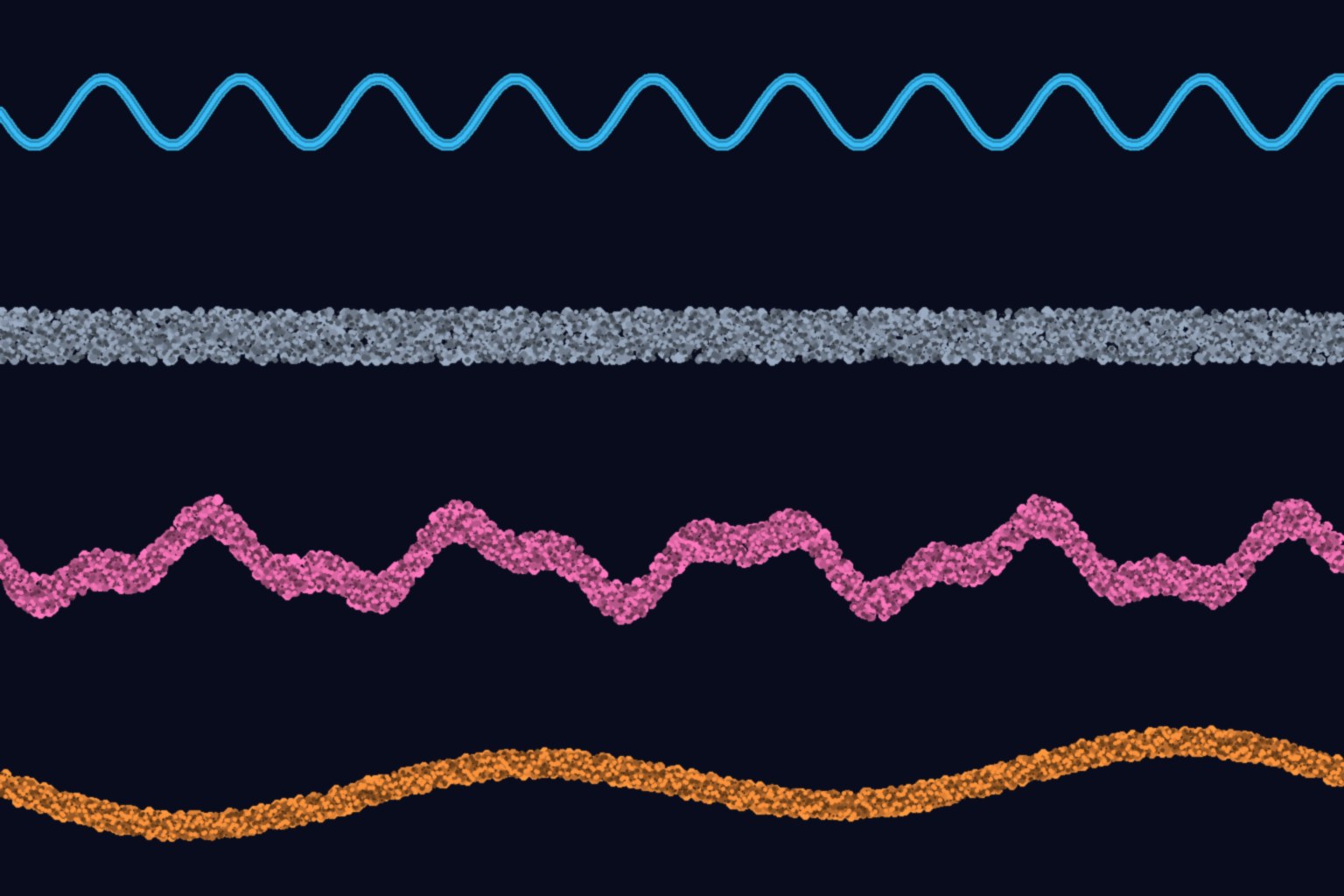
Quick Answer: Which One Should You Use?
For targeting a specific mental state (deep focus, calm, meditation, sleep onset), binaural beats are the most direct tool because they aim to entrain a specific brainwave frequency. For masking distractions and quieting a racing mind, white, pink or brown noise work better — with the deepest evidence for ADHD. For most people, the best setup is both together: a binaural beat for the brainwave target, plus a low layer of noise to block distractions.
| Tool | Mechanism | Best for | Needs headphones? |
|---|---|---|---|
| Binaural beats | Brainwave entrainment | Targeted mental states (focus, sleep, meditation) | Yes (stereo) |
| White noise | Sound masking | Blocking distractions, tinnitus | No |
| Pink noise | Sound masking + deep sleep | Sleep, steady focus | No |
| Brown noise | Sound masking + relaxation | ADHD focus, calming racing thoughts | No |
| Combined | Both | Maximum focus / sleep effect | Yes (stereo) |
What Each Sound Actually Is
Binaural Beats
A binaural beat is not a sound that exists in the world — it is created inside your brain. When you hear a 200 Hz tone in your left ear and a 210 Hz tone in your right ear, your brain perceives a third "beat" pulsing at 10 Hz (the difference between the two tones). This perceived beat is what's thought to entrain your brainwaves via the frequency-following response. Because each ear needs a different frequency, stereo headphones are required. See our complete guide to binaural beats for the full mechanism.
White Noise
White noise contains every audible frequency at equal intensity. It sounds like TV static, a hiss, or the whoosh of an empty radio channel. Its main job is masking — by filling the entire audible spectrum, it covers up sudden distracting sounds (door slams, voices, traffic) so your brain stops noticing them. Some people find pure white noise harsh over long periods.
Pink Noise
Pink noise has more power in the lower frequencies and less in the higher ones. It sounds deeper and softer than white noise — like steady rain, wind through trees, or a steady waterfall. Most people find it more pleasant for extended listening, and it has the strongest evidence for improving deep sleep.
Brown Noise
Brown noise (sometimes called red noise) is deeper still, with energy concentrated in the lowest bass frequencies. It resembles a distant ocean roar, the rumble of an airplane cabin, or a low thunder. Brown noise went viral on TikTok in 2022-2023, particularly in ADHD communities, where users describe it as uniquely effective for quieting racing thoughts. See our ADHD guide for the broader context.
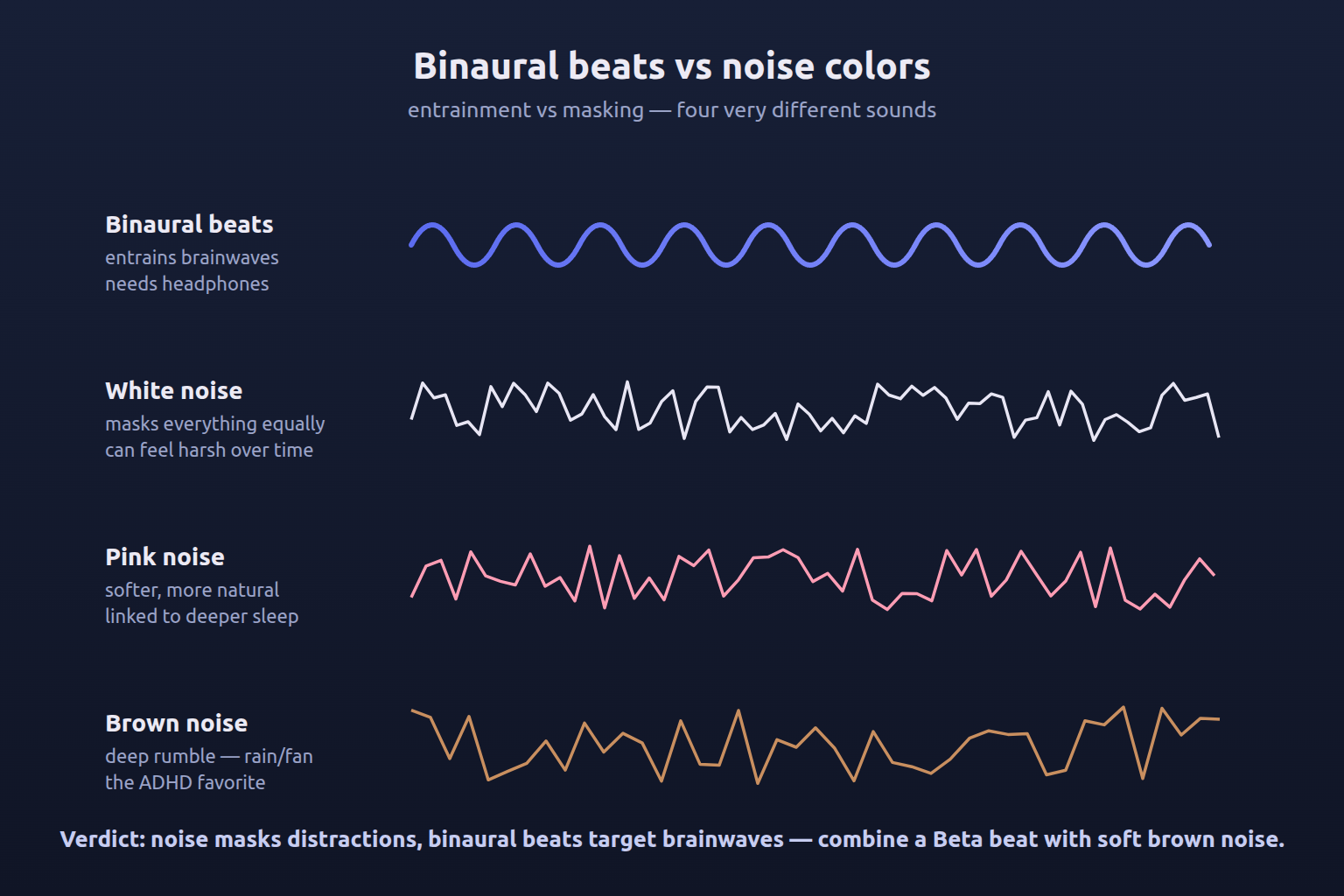
Four different sounds, four different jobs: entrainment vs masking.
What the Science Actually Says (2024 Meta-Analyses)
The popular narrative online is that brown noise is a focus superpower. The science is more cautious. The most rigorous recent review is the 2024 Nigg et al. meta-analysis, published in the Journal of the American Academy of Child & Adolescent Psychiatry, which pooled every well-designed study on white and pink noise for cognition and sleep.
For ADHD Focus
The meta-analysis found a small but significant benefit of white and pink noise on laboratory attention tasks — but only for people with ADHD or high ADHD traits. For neurotypical participants, the same noise actually impaired cognitive performance slightly. The leading theory is that noise acts as an "auditory anchor" — a constant stimulus that occupies the under-aroused ADHD brain and reduces mind-wandering. Neurotypical brains don't need this anchor, so the extra noise just adds cognitive load.
Notably, no clinical studies of brown noise for ADHD existed at the time of the review. The viral brown-noise-for-ADHD trend is built on strong anecdote but thin direct evidence. Researchers believe brown noise likely works through the same auditory-anchor mechanism, but it has not been directly tested.
For Sleep
The sleep evidence is mixed. On the positive side, a 2020 study found that steady pink noise reduced brain-wave complexity and promoted more stable deep sleep. On the negative side, a 2023 Penn Medicine study found that overnight pink noise reduced REM sleep by about 18 minutes and may harm overall sleep quality, memory consolidation, and creative insight. The takeaway: pink noise may deepen sleep but at a potential cost to REM, so it's worth testing personally rather than assuming it's universally good.
For Binaural Beats
A separate 2019 meta-analysis (Garcia-Argibay et al.) found small but reliable effects of binaural beats on anxiety reduction, pain perception, and some cognitive measures. The evidence is comparable in strength to the noise literature — promising but not miraculous. See our focus frequencies guide and anxiety guide for the specifics.
Why Combining Them Works Best
Binaural beats and noise colors solve different problems. Binaural beats target which brainwave state you're in (Beta for alertness, Alpha for calm, Theta for meditation, Delta for sleep). Noise targets what your brain filters out (distractions, sudden sounds, internal chatter). Used together, they cover both sides of the equation.
In practice, the most effective sessions for many users look like this:
- Deep work: 15 Hz Beta binaural beat + low brown noise. The beat drives alert focus; the noise masks office or household sounds.
- Studying: 10 Hz Alpha binaural beat + low pink noise. The beat supports learning and reading; the noise prevents disruptions. See our study protocol.
- Sleep onset: 4 Hz Theta binaural beat + low brown noise. The beat guides your brain toward sleep; the noise masks nighttime sounds.
- Meditation: 7 Hz Theta binaural beat + low pink noise. See our meditation guide.
The key is volume balance: the binaural beat should be the louder, foreground element (set the beat volume so the tone is clearly audible), and the noise should sit quietly underneath it (set noise volume low enough that it never competes with the beat). If the noise is too loud, the binaural effect is weakened because the tones become harder to separate.
How to Choose: Decision Guide
Still unsure which one fits your situation? Use this decision tree:
- "I want to focus but my environment is noisy." Start with pink or brown noise alone — masking is the immediate problem. Add a 15 Hz binaural beat if you also want a cognitive boost.
- "My environment is quiet but my mind is restless." Start with a binaural beat alone — your problem is internal, not external. 15 Hz Beta for active work, 10 Hz Alpha for calm.
- "I have ADHD and need to focus." Try brown or pink noise first (the evidence is strongest for ADHD). Layer in a 15 Hz Beta beat if you want more cognitive drive.
- "I want to fall asleep." 4 Hz Theta binaural beat + low brown or pink noise. Test each noise color for a few nights; the sleep evidence is mixed enough that personal response matters.
- "I want to meditate." 7 Hz Theta binaural beat, no noise. Silence or nature sounds work better than artificial noise here.
- "I'm studying for an exam." 10 Hz Alpha binaural beat + low pink noise. See the full study protocol.
Common Mistakes
"Listening on speakers." Binaural beats do not work on speakers — each ear must receive a different frequency. If you only have speakers, use noise instead. The binaural effect is physically impossible without stereo separation.
"Setting the volume too loud." Both binaural beats and noise work best when the volume is low. Loud volume causes hearing fatigue and headaches, not stronger effects. Aim for "barely audible" — a background presence you notice only when it stops.
"Assuming brown noise is proven for ADHD." The viral trend is real, but the direct clinical evidence is not. Brown noise is worth trying for ADHD focus, but don't expect a miracle — the strongest evidence is for white and pink noise, and even that shows small effects.
"Using pink noise every night long-term." The 2023 Penn Medicine study suggests overnight pink noise may reduce REM sleep. If you use it nightly, pay attention to whether you feel less creative or less rested, and consider alternating nights.
"Mixing everything at once." More is not better. One binaural beat + one noise color is plenty. Stacking multiple beats or noise types creates a muddy signal that the brain can't entrain to.
Try Them All — Free
The fastest way to know what works for you is to experiment. Our free generator lets you combine any binaural beat frequency with white, pink or brown noise (plus rain, wind and other nature sounds) — all in real time, with no signup, no ads, and no audio compression. Spend 10 minutes with each option and notice how your mental state shifts.
If you already know what you need, jump straight in:
- 15 Hz Beta + Brown Noise — deep focus
- 10 Hz Alpha + Pink Noise — calm studying
- 4 Hz Theta + Brown Noise — sleep onset
For more on each topic, browse the full guide library — including our deep sleep guide, stress relief guide, and binaural vs isochronic tones comparison.
Frequently Asked Questions
Are binaural beats better than white, pink, or brown noise?
What is the difference between white, pink and brown noise?
Does brown noise help with ADHD focus?
Which noise color is best for sleep?
Can I listen to binaural beats and brown noise at the same time?
Do I need headphones for binaural beats or noise?
Is white noise bad for you?
Scientific References
- Nigg, J. T., et al. (2024). Do White Noise or Pink Noise Improve Cognition or Sleep in Individuals With ADHD or Healthy Controls? A Systematic Review and Meta-Analysis. Journal of the American Academy of Child & Adolescent Psychiatry, 63(8), 819-832.
- Lu, S. Y., et al. (2020). Spectral content (colour) of noise exposure affects work performance and psychological comfort: an EEG study. International Journal of Environmental Research and Public Health, 18(2), 544.
- Zhang, L., et al. (2023). Effects of steady pink noise on sleep structure and cognitive performance. Nature and Science of Sleep, 15, 145-157.
- Garcia-Argibay, M., Santed, M. A., & Reales, J. M. (2019). Efficacy of binaural auditory beats in cognition, anxiety, and pain perception: a meta-analysis. Frontiers in Human Neuroscience, 13, 35.
- Penn Medicine (2023). Pink noise reduces REM sleep and may harm sleep quality, study suggests.
Donate $15+ to unlock premium as our thank-you
BinauralPure is free and ad-free, forever. It is an independent project with no investors. Donate any amount to keep it alive — $15 or more unlocks every premium feature (HD downloads, multi-track sessions, 5-hour timers, and more) for life. No subscription, no renewals.