Tinnitus — the persistent ringing, buzzing, or hissing in the ears with no external source — affects roughly 15% of adults and has spawned an entire industry of "cures." Search for "binaural beats for tinnitus" and you will find hundreds of YouTube videos and articles promising relief. This guide gives you the honest, evidence-based version: what binaural beats can do for tinnitus (genuine but limited), what they cannot do (cure it), and what science actually recommends as the gold-standard treatments.
The short version: binaural beats will not cure your tinnitus, but they can help with the anxiety, stress, and sleep disruption that make tinnitus feel louder and more distressing. They are a complementary coping tool, not a treatment.
Photo: Valeriia Miller on Unsplash
Quick Answer: What Binaural Beats Can and Can't Do for Tinnitus
Let's be honest upfront. Tinnitus is a complex neurological condition usually involving some degree of auditory system damage or dysfunction. No audio therapy — binaural beats, white noise, or otherwise — can repair that underlying damage. Anyone claiming that binaural beats cure tinnitus is misrepresenting the science.
What binaural beats can realistically do is reduce three things that make tinnitus feel unbearable:
- Stress and anxiety — which amplify perceived tinnitus loudness
- Sleep disruption — tinnitus often worsens at night when there is no background noise to mask it
- Attention fixation — a calm, entrained brain focuses less on the ringing
A 2022 study by Ibarra-Zarate et al. found that binaural sound therapy reduced stress in 23% of tinnitus patients and reduced tinnitus perception in about 15%. That is meaningful relief for some people, but not a cure for everyone.
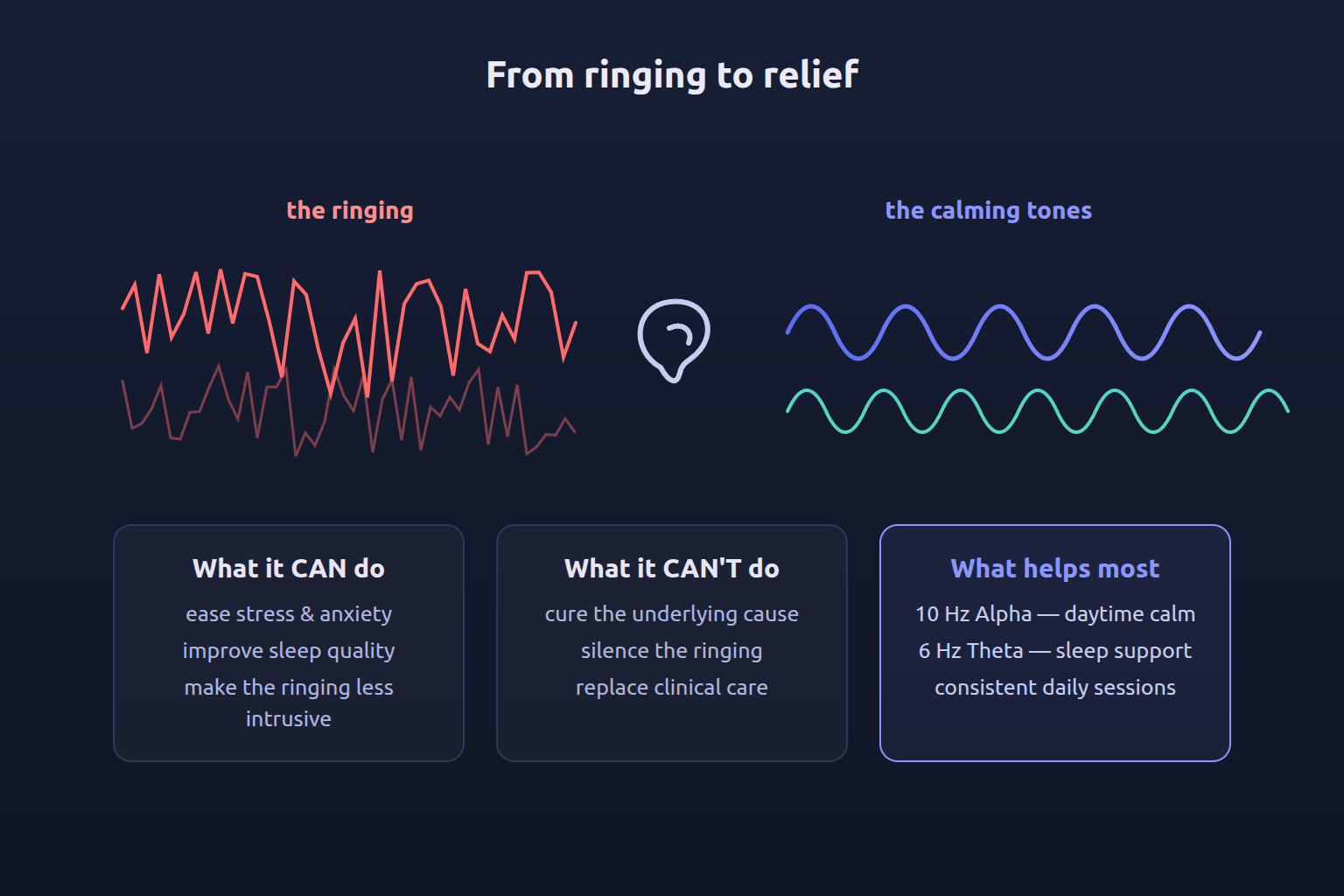
The honest summary: what binaural beats can and can't do for tinnitus, and the frequencies that help most.
| Claim | Evidence | Verdict |
|---|---|---|
| Cures tinnitus | None | False |
| Reduces tinnitus-associated stress | Ibarra-Zarate 2022: 23% benefited | Real, moderate |
| Reduces tinnitus perception (masking) | Ibarra-Zarate 2022: ~15% benefited | Real, moderate |
| Improves tinnitus-related sleep issues | Indirect (Delta sleep evidence) | Likely helpful |
| Replaces TRT, CBT, or hearing aids | None | False |
What the Clinical Evidence Shows
The Ibarra-Zarate 2022 Trial
The most direct study on binaural beats for tinnitus is Ibarra-Zarate et al. (2022), a randomized controlled trial. They tested binaural sound therapy (BST) on tinnitus patients and found it produced comparable results to standard masking therapy: 23% of patients reported reduced stress, and about 15% reported reduced tinnitus perception. Importantly, the benefits were similar to those of standard sound masking — meaning binaural beats are a reasonable alternative to white noise masking for people who find pure white noise harsh.
The 2025 Time-Bound Review
A 2025 review by Prakash et al., published in the International Tinnitus Journal, evaluated the time-bound efficacy of binaural beats for tinnitus. The review concluded that binaural beats may help reduce tinnitus by promoting relaxation through brainwave entrainment, which can partially or completely mask the tinnitus sound for some listeners — but emphasized that results are inconsistent and that more rigorous research is needed.
What the Audiology Field Actually Recommends
The American Tinnitus Association and Cochrane reviews point to three gold-standard treatments with the strongest evidence base:
- Tinnitus Retraining Therapy (TRT) — combines directive counseling with low-level sound therapy over 12-18 months to help the brain habituate to the tinnitus signal. The Jastreboff model on which it is based is the most widely accepted framework in audiology.
- Cognitive Behavioral Therapy (CBT) — addresses the anxiety, depression, and distress tinnitus causes. Has the strongest evidence base of any psychological intervention for tinnitus.
- Hearing aids — when tinnitus accompanies hearing loss (very common), amplifying external sound can naturally mask the tinnitus and reduce the brain's compensatory hyperactivity.
Specialized sound-based therapies include notch therapy (filtering out your specific tinnitus frequency from broadband sound, built into hearing aids like Signia) and ACRN (acoustic coordinated reset neuromodulation). These are different mechanisms from binaural beats and require professional setup. Binaural beats are not in this category — they are a home-use relaxation tool that can complement, but not replace, these treatments.
How Binaural Beats Help With Tinnitus: The Three Pathways
1. Stress and Anxiety Reduction
Stress is the single biggest amplifier of tinnitus perception. When you are stressed, your nervous system is on high alert and your brain tunes in more strongly to threat signals — including the internal "threat" of tinnitus. Alpha binaural beats (8-12 Hz) shift the brain into a calm, relaxed state, which can dial down the perceived loudness of tinnitus. This is the most reliable pathway by which binaural beats help tinnitus patients. See our anxiety guide for the underlying mechanism.
2. Masking Effect
Like white noise or nature sounds, binaural beats provide a steady audio signal that partially covers the tinnitus tone. This is the same principle as the sound generators used in TRT. Some patients find binaural beats more pleasant than pure white noise for extended listening. Brown or pink noise layered underneath the binaural beat can enhance the masking effect — see our binaural vs noise comparison.
3. Sleep Support
Tinnitus often becomes unbearable at night, when there is no background noise to mask it, which destroys sleep — and poor sleep makes tinnitus feel louder the next day, in a vicious cycle. Delta binaural beats (0.5-4 Hz) help with sleep onset and deep sleep, breaking the cycle. The Dabiri 2022 study confirmed delta binaural beats improve sleep quality, which indirectly supports tinnitus management. See our deep sleep guide for the full protocol.
A Practical Protocol for Tinnitus Management
If you want to try binaural beats as a complementary tool for tinnitus, here is a safe, evidence-informed protocol:
- See an audiologist or ENT doctor first. Get a proper diagnosis, hearing test, and a recommended treatment plan. Tinnitus can have treatable causes (earwax impaction, TMJ, vascular issues) that no audio will fix.
- Use Alpha (8-10 Hz) during the day for stress. 30-minute sessions when anxiety spikes or when tinnitus feels loud. Pair with slow breathing or meditation.
- Use Theta (4-7 Hz) for deep relaxation. When tinnitus distress is high, theta promotes deeper calm than alpha. See our stress relief guide.
- Use Delta (0.5-4 Hz) before bed for sleep. 30 minutes, lights dimmed, no screen. This is often the highest-value session for tinnitus patients because sleep is where tinnitus does the most damage.
- Layer with brown or pink noise for masking. A quiet bed of brown noise under the binaural beat helps cover the ringing while the beat calms the mind.
- Keep the volume very low. Barely audible — especially important for tinnitus patients, where loud volume can temporarily worsen the ringing or aggravate hyperacusis.
- Avoid frequencies near your tinnitus pitch. If your tinnitus is a high whistle (common), avoid high carrier frequencies that compete with it. Stick to lower, gentler tones.
- Take breaks every 30 minutes. Stop immediately if the ringing gets louder, and do not use binaural beats for hours on end.
- Persist for 2-4 weeks. Like TRT, the benefits of relaxation and habituation build over time. A single session will not tell you much.
- Pair with professional treatment. Use binaural beats alongside (not instead of) TRT, CBT, hearing aids, or whatever your audiologist recommends.
What Can Go Wrong — and How to Avoid It
Tinnitus patients are vulnerable to two things: false hope from "miracle cures," and well-meaning advice that backfires. Be aware of these pitfalls:
- Do not believe "cure" claims. If a video or product claims binaural beats will eliminate your tinnitus, it is dishonest. There is no cure for most forms of tinnitus. Real relief comes from habituation and stress reduction.
- Volume can backfire. Some Reddit users report their tinnitus temporarily worsened after loud binaural sessions. Keep the volume barely audible, especially if you have any hearing loss or hyperacusis.
- High-frequency content can clash. If your tinnitus is a high-pitched ring, binaural beats with high carrier frequencies may make it more noticeable. Lower carrier frequencies (around 100-200 Hz) tend to work better.
- Do not delay professional care. If your tinnitus is new (under 6 months), unilateral (one ear only), pulsatile (in sync with your heartbeat), or accompanied by dizziness or hearing loss, see a doctor promptly. These can indicate treatable underlying conditions.
- Hyperacusis caution. If you have decreased sound tolerance, even moderate volumes can cause discomfort. Start extremely low and consult your audiologist before adding any sound therapy.
The Honest Path Forward
Tinnitus is one of the most frustrating conditions to live with, and the desperation for relief makes it easy to fall for exaggerated claims. Binaural beats are not a cure, but they are a legitimate complementary tool: they reduce stress, support sleep, and provide a gentle masking effect — three things that genuinely lower the day-to-day burden of tinnitus. Used alongside professional treatment, they can be part of a real management strategy.
For best results: see an audiologist for a proper plan, use Alpha or Theta binaural beats during stressful periods, use Delta before bed, layer with brown noise for masking, keep the volume low, and persist for several weeks. The goal is not to eliminate tinnitus — it is to make it matter less in your life.
Our free generator lets you create any binaural frequency from Delta to Gamma with optional background noise — no signup, no ads, no audio compression. For more on related topics, browse our full guide library.
Frequently Asked Questions
Can binaural beats cure tinnitus?
Can binaural beats help with tinnitus at all?
What is the best frequency for tinnitus?
What is notch therapy for tinnitus?
What is the difference between binaural beats and sound therapy for tinnitus?
Can binaural beats make tinnitus worse?
What is the most effective treatment for tinnitus?
Is it safe to use binaural beats with hearing loss or hyperacusis?
Scientific References
- Ibarra-Zarate, J. I., et al. (2022). Binaural sound therapy for the treatment of tinnitus: a randomized controlled trial. Journal of Personalized Medicine, 11(9), 902.
- Prakash, P., et al. (2025). Evaluating time-bound efficacy of binaural beats for tinnitus. International Tinnitus Journal.
- Phillips, J. S., & McFerran, D. (2010). Tinnitus Retraining Therapy (TRT) for tinnitus. Cochrane Database of Systematic Reviews.
- American Tinnitus Association. Sound therapy for tinnitus.
- American Tinnitus Association. Cognitive Behavioral Therapy versus Tinnitus Retraining Therapy.
Donate $15+ to unlock premium as our thank-you
BinauralPure is free and ad-free, forever. It is an independent project with no investors. Donate any amount to keep it alive — $15 or more unlocks every premium feature (HD downloads, multi-track sessions, 5-hour timers, and more) for life. No subscription, no renewals.