Of all the frequencies used in brainwave entrainment, 40 Hz gamma has the most fascinating backstory: it is the only one with a credible connection to a decade of MIT neuroscience research on Alzheimer's disease. The story is genuinely exciting — and frequently misrepresented online. This guide separates what the MIT lab actually found from what 40 Hz binaural beats can realistically do for your memory and cognition.
We will cover the science, explain the crucial difference between "40 Hz binaural beats" and "40 Hz sensory stimulation" (the two get conflated constantly), and give you a practical protocol for using 40 Hz to support memory and focus.
Quick Answer: What 40 Hz Gamma Does
Gamma brainwaves (32-100 Hz) are the fastest oscillations in the human brain, associated with focused attention, working memory, problem-solving, and the integration of information across brain regions. 40 Hz is the most studied gamma frequency, and there is solid evidence that 40 Hz binaural beats can improve working memory and cognitive performance in healthy adults after a single 20-30 minute session. The Alzheimer's connection is real but specific to a different delivery method (sensory stimulation, not binaural) — more on that below.
| Benefit | Evidence | Delivery |
|---|---|---|
| Improved working memory | Wang & Zhang (2022) | Binaural beats |
| Better cognition & mood | Sharpe et al. (2020): 75% → 85% cognitive score | Binaural beats |
| Cognitive lift in healthy adults | SAS study: single 20-min session | Binaural beats |
| Slowed Alzheimer's progression | MIT Tsai lab (2016-2025) | Sensory stimulation (light + sound) |
What Are Gamma Brainwaves?
Gamma is the fastest of the five main brainwave bands. While Delta (0.5-4 Hz) dominates deep sleep and Beta (13-30 Hz) dominates active concentration, Gamma (32-100 Hz) appears during the brain's most demanding and integrated moments: when you are solving a hard problem, recalling a specific memory, linking ideas together, or sustaining peak attention. Researchers believe gamma reflects the brain's ability to bind together information from different regions into a single conscious experience.
Low or disrupted gamma activity has been linked to cognitive decline, which is what drew Alzheimer's researchers to the frequency in the first place. Higher gamma power, by contrast, correlates with sharper cognition — hence the interest in gamma for focus and memory enhancement.
The MIT Alzheimer's Research: What They Actually Found
The 40 Hz story became famous because of the lab of Li-Huei Tsai at MIT's Picower Institute, who has spent the last decade studying how stimulating gamma rhythms affects the brain. Here is what the research actually shows, in plain terms:
- 2016-2019 (mouse studies): Tsai's team discovered that exposing mice to a 40 Hz flickering light reduced amyloid plaques in the visual cortex by activating microglia (the brain's immune cells). Adding 40 Hz sound extended the effect across more of the brain.
- 2019-2022 (early human trials): They translated this into a device that delivers 40 Hz light flicker plus 40 Hz clicking sound to patients with mild cognitive impairment and early Alzheimer's. The treatment was safe, well-tolerated, and showed early signals of benefit.
- 2025 (latest review): The MIT team reported that Alzheimer's patients exposed to 40 Hz audiovisual stimulation experienced a significant slowing of brain atrophy and improvements on some cognitive measures — the strongest human evidence to date.
This is genuinely groundbreaking research. But here is the catch that most online articles skip:
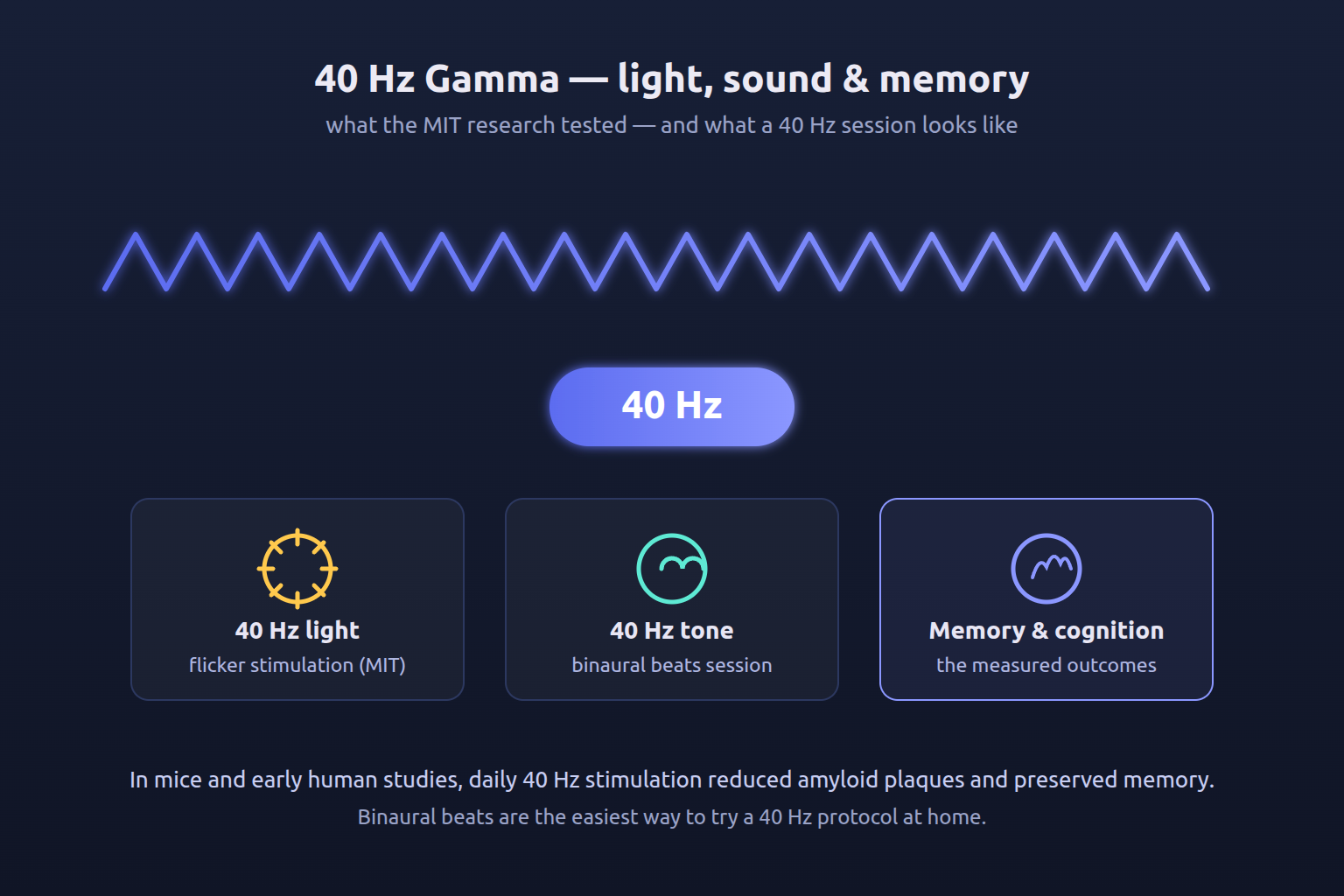
The 40 Hz protocol at a glance: sensory stimulation in research, binaural beats at home.
The Critical Distinction: Sensory Stimulation vs Binaural Beats
The MIT research uses 40 Hz sensory stimulation — a device that delivers a 40 Hz flickering light and a 40 Hz clicking sound at the same time. The light component is essential; the sound alone is not the same intervention. This is a fundamentally different mechanism from 40 Hz binaural beats, which use two slightly different pure tones in each ear to create a perceived 40 Hz beat inside your brain (see our binaural beats explainer for the underlying physics).
| Aspect | 40 Hz sensory stimulation (MIT) | 40 Hz binaural beats |
|---|---|---|
| How it works | 40 Hz light flicker + 40 Hz clicking sound | Two pure tones, 40 Hz apart, in each ear |
| Requires headphones | No | Yes (stereo) |
| Requires light | Yes (essential) | No |
| Alzheimer's evidence | Strong (MIT, 2016-2025) | None directly |
| Cognitive evidence in healthy adults | Limited | Moderate (memory & cognition studies) |
Anyone claiming "40 Hz binaural beats cure Alzheimer's" is misrepresenting the research. The honest version: both methods aim to entrain gamma brainwaves, but only the MIT sensory stimulation protocol has been clinically tested for Alzheimer's. If you or a family member are concerned about Alzheimer's, please consult a neurologist — audio is not a substitute for medical care.
What 40 Hz Binaural Beats Can Do for Healthy Adults
Setting Alzheimer's aside, there is real evidence that 40 Hz binaural beats improve cognition in healthy adults. Three studies stand out:
- Sharpe et al. (2020, Brain Stimulation): participants who received gamma binaural beat entrainment saw their cognitive test scores rise from an average of 75% to 85% — a meaningful improvement — with parallel improvements in mood.
- Wang & Zhang (2022): a study specifically on 40 Hz binaural beats found measurable improvements in working memory and increased neural complexity (Higuchi's Fractal Dimension) in the temporal lobe, suggesting the brain was genuinely working harder and more efficiently during the task.
- SAS Publishers study: a single 20-minute 40 Hz binaural beat session was enough to lift cognitive performance in healthy subjects, suggesting the effect is fast-acting, not something that requires weeks of practice.
The honest summary: 40 Hz binaural beats will not turn you into a genius, but the evidence supports a real, moderate boost to working memory and cognitive performance, especially during demanding tasks. If you have ever used Beta frequencies for focus, 40 Hz gamma is the more intense, higher-frequency cousin — sharper and more activating.
A Practical Protocol for Using 40 Hz
Based on the research, here is a protocol to get the most out of 40 Hz gamma:
- Use it during demanding cognitive work. 40 Hz is an activating frequency, so pair it with the hardest task of your day: deep work, complex problem-solving, writing, learning new material. See our study protocol for context.
- Sessions of 20-30 minutes. The SAS study showed benefits from 20 minutes; the Sharpe study used 30 minutes. Set a timer — going longer does not appear to multiply the benefit and can cause mental fatigue.
- Wear stereo headphones. Binaural beats are physically impossible without stereo separation. Any headphones work — see our headphones guide.
- Set the volume low. The tones should be barely audible, a background presence. Loud volume causes fatigue, not stronger entrainment.
- Combine with brown or pink noise (optional). A low layer of brown or pink noise can mask distractions while the 40 Hz beat drives the cognitive effect.
- Avoid in the evening. Gamma is stimulating. If you use it before bed, you may struggle to sleep. For evening sessions, switch to Theta (4-7 Hz) or Delta (0.5-4 Hz) — see our deep sleep guide.
Who Should (and Shouldn't) Use 40 Hz Gamma
Try it if: you want to sharpen working memory before demanding tasks, you are studying for an exam, you do focused creative or analytical work, or you are curious about the most-studied gamma frequency. Effects are fast (single session) and the tool is free.
Skip it if: you are prone to anxiety or overstimulation (40 Hz can feel intense — try 10 Hz Alpha instead), you want to relax or sleep, or you have photosensitive epilepsy (the binaural delivery is fine, but if you are also considering light-based gamma devices, consult your doctor first).
For Alzheimer's concerns: 40 Hz binaural beats are not a treatment. The MIT research is exciting but it uses a different method. If you are worried about cognitive decline in yourself or a family member, the right step is a conversation with a neurologist — not self-medication with audio.
Try 40 Hz Gamma — Free
The fastest way to understand 40 Hz gamma is to experience it. Put on headphones, set the generator to a 40 Hz beat, keep the volume low, and work on your hardest cognitive task for 20 minutes. Notice whether your thinking feels sharper, your focus tighter, or your recall faster than usual.
Our free generator lets you set any frequency up to 100 Hz — including 40 Hz gamma — with optional background noise, no signup, no ads, and no audio compression. For a deeper dive into how frequencies map to mental states, browse our full guide library.
Frequently Asked Questions
Do 40 Hz binaural beats help with Alzheimer's?
Do 40 Hz binaural beats improve memory in healthy adults?
What is the difference between 40 Hz binaural beats and 40 Hz sensory stimulation?
What are gamma brainwaves and why does 40 Hz matter?
How long should I listen to 40 Hz binaural beats?
Can I use 40 Hz binaural beats every day?
Do I need special equipment for 40 Hz binaural beats?
Scientific References
- Picower Institute, MIT (2025). Evidence that 40Hz gamma stimulation promotes brain health, expanding. MIT News.
- Picower Institute. 40Hz rhythms fight Alzheimer's at the cellular and molecular level. Massachusetts Institute of Technology.
- Sharpe, R. L., et al. (2020). Gamma entrainment frequency affects mood, memory and cognition: an exploratory pilot study. Brain Stimulation, 13(4), 929-937.
- Wang, B., & Zhang, J. (2022). The effect of 40 Hz binaural beats on working memory. Conference proceedings.
- Chen, X., et al. (2025). 40 Hz multisensory stimulation therapy for cognitive impairment: mechanisms and clinical translation. Frontiers in Aging Neuroscience.
- Garcia-Argibay, M., Santed, M. A., & Reales, J. M. (2019). Efficacy of binaural auditory beats in cognition, anxiety, and pain perception: a meta-analysis. Frontiers in Human Neuroscience, 13, 35.
Donate $15+ to unlock premium as our thank-you
BinauralPure is free and ad-free, forever. It is an independent project with no investors. Donate any amount to keep it alive — $15 or more unlocks every premium feature (HD downloads, multi-track sessions, 5-hour timers, and more) for life. No subscription, no renewals.